Closed trials
MR ASAP
Multicentre Randomised trial of Acute Stroke treatment in the Ambulance with a nitroglycerin Patch
MR ASAP is part of the Collaboration for New Treatments of Acute Stroke. The CONTRAST consortium aims to improve outcome in stroke patients by merging translational research and pragmatic randomised clinical trials.
In MR ASAP, we will determine the effect of prehospital transdermal nitroglycerin, given within 3 hours of stroke onset, on functional outcome at 90 days in patients with acute ischaemic stroke or intracerebral haemorrhage. Trained paramedics from ± 10 ambulance regions in the Netherlands will recruit a total of 1400 patients.
MR ASAP Rationale and aim
Despite recent advances in the treatment of patients with acute ischaemic stroke or intracerebral haemorrhage (ICH), about half of the patients still have a poor outcome. The available treatments with the largest benefit, intravenous thrombolysis and endovascular treatment, are available for a relatively small proportion of patients. Hence, there is a need for additional treatment available for a larger group of stroke patients, preferably applicable very soon after symptom onset according to the ‘time is brain’ principle.
A potential therapeutic target in patients with acute stroke is the improvement of collateral perfusion and reduction of blood pressure. Recent studies have suggested that transdermal administration of glyceryl trinitrate (GTN; nitroglycerin), in the first hours after symptom onset, increases the chance of a favourable outcome after stroke, possibly through an increase in intracranial collateral blood flow and a reduction in blood pressure. The Multicentre Randomised trial of Acute Stroke treatment in the Ambulance with a nitroglycerin Patch (MR ASAP) aims to assess the effect of transdermal GTN, started within three hours of stroke onset in the prehospital setting, on functional outcome at 90 days in patients with acute ischaemic stroke or intracerebral haemorrhage.
The primary objective of MR ASAP is to assess the effect of transdermal GTN, started within 3 hours of symptom onset in the prehospital setting, on functional outcome at 90 days in patients with acute ischaemic stroke or intracerebral haemorrhage. Secondary objectives are to assess whether the effects of transdermal GTN on functional outcome are consistent across specific subgroups of patients, i.e., those with 1. ischaemic stroke; 2. ischaemic stroke treated with endovascular techniques; or 3. intracerebral haemorrhage; and to assess the effect of GTN on collaterals, size of the ischemic core and salvageable brain tissue on admission to the hospital.
MR ASAP Study design
Design
MR ASAP is a phase III, multicentre, prospective, randomised, open-label clinical trial with blinded endpoint assessment (PROBE) of transdermal GTN in a dose of 5 mg/day for one day in 1400 patients with suspected stroke.
Patient population
The study population will consist of adult patients in whom the attending paramedic makes the probable diagnosis of acute stroke with a moderately severe to severe deficit. Eligibility criteria are listed below. These criteria are checked by the paramedic in the ambulance and the exclusion criteria should be checked again upon arrival to the hospital, by the treating physician. If an exclusion criterion appears to have been missed by the paramedic, the GTN patch (if randomised to GTN) should be removed.
| Inclusion criteria |
| Age ≥ 18 years |
| Probable diagnosis of acute stroke, as assessed by the paramedics in the prehospital setting |
| Score of 2 or 3 on the Face Arm Speech Test (FAST) |
| Systolic blood pressure ≥ 140 mm Hg |
| Possibility to start the trial treatment within 3 hours of symptom onset |
| Intention to transport the patient to one of the participating hospitals |
| Wirtten informed consent (deferred) |
| Exclusion criteria |
| Considerable pre-stroke dependency in activities of daily living, defined as staying in a chronic nursing home or rehabilitation centre |
| Known pregnancy or lactation |
| Indication for acute treatment with nitroglycerin or knwon use of nitroglycerin in the previous 12 hours |
| Known hypersensitivity to nitroglycerin, nitrates in general or adhesiv used in the past |
| Glasgow Coma Scale < 8 |
| Known with any of the following heart disorders: myocardial insufficiency due tot obstruction; aortis or mitral valve stenosis; constrictive pericarditis; hypertrophic obstructive cardiomyopathy; cardiac tamponade |
| Known marked anaemia, defined as haemoglobin < 5 mmol/l |
| Known closed angle glaucoma |
| Known use of phosphodiesterase type-5 inhibitors (e.g. sildenafil) |
Randomisation and treatment
Patients will be randomly allocated to open-label GTN (5 mg/24 hours) administered as a transdermal patch by paramedics in the prehospital setting within 3 hours of stroke onset and continued for 24 hours in addition to standard care, or to standard care alone. Randomisation will be through a secure web-based electronic application, which has real-time data validation. If patients are randomised to treatment with GTN but prove not to have a transient ischaemic attack (TIA) or stroke after examination in the hospital, the patch will be removed.
Primary outcome
The main study outcome is the score for functional outcome on the modified Rankin Scale (mRS) at 90 (± 14) days, analysed with ordinal logistic regression.
Informed consent
This study evaluates a treatment initiated by paramedics as soon as possible after stroke onset. Since most patients with acute neurological deficits are not capable of decision making, and to reduce treatment delays, MR ASAP uses a deferred informed consent procedure, in line with Dutch law (Dutch Medical Research (Human Subjects) Act: 6,4). This implicates that patients are included and may receive the GTN patch in the ambulance before consent is obtained. Written informed consent should be obtained as soon as possible, preferably within 24 hours after hospital admission. In patients randomised to GTN who decline to participate, study medication will be stopped immediately.
MR ASAP Trial organization
MR ASAP will be conducted by members of the CONTRAST consortium.
The MR ASAP project is led by:
H. Bart van der Worp, MD PhD
Chief Investigator MR ASAP
Department of Neurology and Neurosurgery
University Medical Center Utrecht (Sponsor)
Paul J. Nederkoorn, MD PhD
Co-Chief Investigator MR ASAP
Department of Neurology
Academic Medical Center
For contact information, see CONTACT.
Trial organization
The MR ASAP trial will be conducted in a maximum of 10 ambulance regions in the Netherlands. Below, you will find the participating centers per ambulance region.
| Ambulance region | Center | City | Local Investigator |
| Amsterdam | Ambulance Amsterdam | Amsterdam | A. Siegers, MD |
| Amsterdam UMC – location VUmc | Amsterdam | M.C. Visser, MD PhD | |
| Amsterdam UMC – location AMC | Amsterdam | P.J. Nederkoorn, MD PhD | |
| OLVG Hospital | Amsterdam | V.I.H. Kwa, MD PhD | |
| Waterland Hospital | Purmerend | C.P. Zwetsloot, MD PhD | |
| Utrecht | Regional Ambulance Organisation Utrecht | Utrecht | R.A. Boomars, MPA |
| University Medical Center Utrecht | Utrecht | H.B. van der Worp, MD PhD | |
| Sint Antonius Hospital | Nieuwegein | W.J. Schonewille, MD PhD | |
| Diakonessen Hospital | Utrecht | R.C.J.M. Donders, MD PhD | |
| Meander Medical Center | Amersfoort | T.W.M. Raaijmakers, MD PhD | |
| Zwolle | Regional Ambulance Organisation IJsselland | Zwolle | K. Caminada, MD |
| Isala Hospital | Zwolle | P.S.S. Fransen, MD PhD | |
| Deventerziekenhuis | Deventer | M.H. Schipper, MD | |
| Arnhem | Ambulance Gelderland-Midden | Arnhem | A. Gerritsen, MPA |
| Rijnstate Hospital | Arnhem | J. Hofmeijer, MD PhD | |
| Hospital Gelderse Vallei | Ede | I. Miedema, MD PhD | |
| Slingeland Hospital | Doetinchem | J.A. van Vliet, MD PhD | |
| Papendrecht | Zuid-Holland Zuid | Papendrecht | L. Esteve Cuevas, MD |
| Albert Schweitzer Hospital | Dordrecht | H. Kerkhoff, MD PhD | |
| Beatrix Hospital | Gorinchem | R. van Eijkelenburg, MD PhD | |
| Nijmegen | Gelderland-Zuid | Nijmegen | P. van Grinsven, MD PhD |
| Radboud UMC | Nijmegen | F-E. de Leeuw, MD PhD | |
| Rivierenland Hospital | Tiel | J. Boomsma, MD PhD | |
| Canisius Wilhelmina Hospital | Nijmegen | G. van Dijk MD PhD |
More participating centers will be added during the course of this trial.
MR ASAP Contact
Coordinating Investigator
Simone Uniken Venema, MD
Department of Neurology and Neurosurgery
Brain Center
University Medical Center Utrecht
Heidelberglaan 100
3584 CX Utrecht
Email: mrasap@umcutrecht.nl
Telephone 24/7: 0031 6 51871901
Chief Investigators
Dr. H. Bart van der Worp, MD PhD
Department of Neurology and Neurosurgery
Brain Center Rudolf Magnus
University Medical Center Utrecht
Heidelberglaan 100
3584 CX Utrecht
h.b.vanderworp@umcutrecht.nl
Dr. Paul J. Nederkoorn, MD PhD
Department of Neurology
Academic Medical Center
Meibergdreef 9
1105 AZ Amsterdam
p.j.nederkoorn@amsterdamumc.nl
Who is who
Simone Uniken Venema
Simone is a PhD candidate at the University Medical Center Utrecht and is the current MR ASAP trial coordinator. She started her PhD in September 2019.
Email: s.m.unikenvenema@umcutrecht.nl
Bart van der Worp
Bart van der Worp is a neurologist with a special interest in cerebrovascular diseases at the University Medical Center in Utrecht, the Netherlands. He has been (co-)Chief Investigator of the randomised clinical trials HAMLET, PAIS, COOLIST, and VAST and is (co-)Chief Investigator of PRECIOUS (www.precious-trial.eu), APACHE-AF (www.apache-af.nl), and MR ASAP. Bart is President of the European Stroke Organisation (ESO; http://eso-stroke.org).
Paul Nederkoorn
Dr. Paul Nederkoorn is stroke neurologist and clinical epidemiologist at the Amsterdam University Medical Centers (Amsterdam UMC), at the AMC location. This large comprehensive stroke center treats approximately 1200 stroke patients per year and performs over 200 intra-arterial trombectomy procedures per year. The core of the research work of the team of Dr. Nederkoorn is patient oriented studies in stroke, focusing on clinical burning questions in stroke that can be answered with pragmatic, investigator driven studies. An example is the recently finished Preventive Antibiotics in Stroke Study (PASS), a study that we designed after seeing so many post-stroke infections worsening our patients in real life. Dr. Nederkoorn is also doing research and is clinical expert in carotid artery disease.
MR ASAP Trial progress
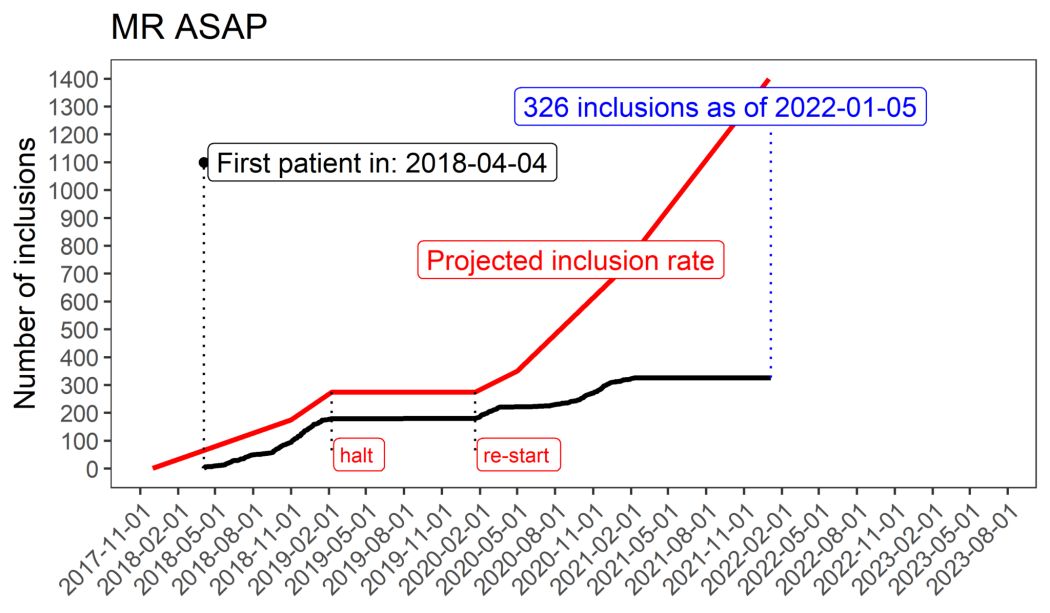
Ethics approval was obtained October 19th 2017, from the Ethics Committee of the Erasmus MC University Medical Center. The first patient was included on April 4th 2018. By November 22nd 2018, four ambulance services were recruiting patients, with 13 participating hospitals.
In February 2019, a trial comparable to MR ASAP was published. This trial, RIGHT-2, also an ambulance-based trial, tested nitroglycerin administered within 4 hours from symptom onset in patients with presumed stroke, and overall, nitroglycerin had no effect on functional outcome at 90 days poststroke. This neutral result prompted a temporary halt of inclusions in MR ASAP to conduct a Data Safety Monitoring Board (DSMB) analysis of the first 100 included patients in MR ASAP.
After receiving a positive advice from the DSMB to continue recruitment of patients in MR ASAP, we re-started including patients in January 2020.
Unfortunately, recruitment was halted again on March 20th 2020 due to the consequences of the COVID-19 crisis and its impact on the healthcare system, which has resulted in a further setback in inclusions. From June 15th 2020 onwards, recruitment re-started again and we’re hopeful that we will increase our inclusion rate after the initiation of two additional ambulance regions, which will hopefully allow us to reach our set milestones without too much delay.
In February 2021 recruitment was temporarily put on hold on advise of the DSMB after an interim analysis. More information will follow in the coming months.