

Closed trials
MR CLEAN LATE
Endovascular Treatment of Acute Stroke for Late arrival
This website provides information about the MR CLEAN LATE trial, a multicenter randomized clinical performed within the CONTRAST consortium. The goal is to assess the effect of endovascular treatment, compared with best medical treatment, in patients with acute ischemic stroke presenting between 6 and 24 hours after onset (or last seen well) caused by an intracranial large vessel occlusion of the anterior circulation.
Final patient included in the MR CLEAN LATE
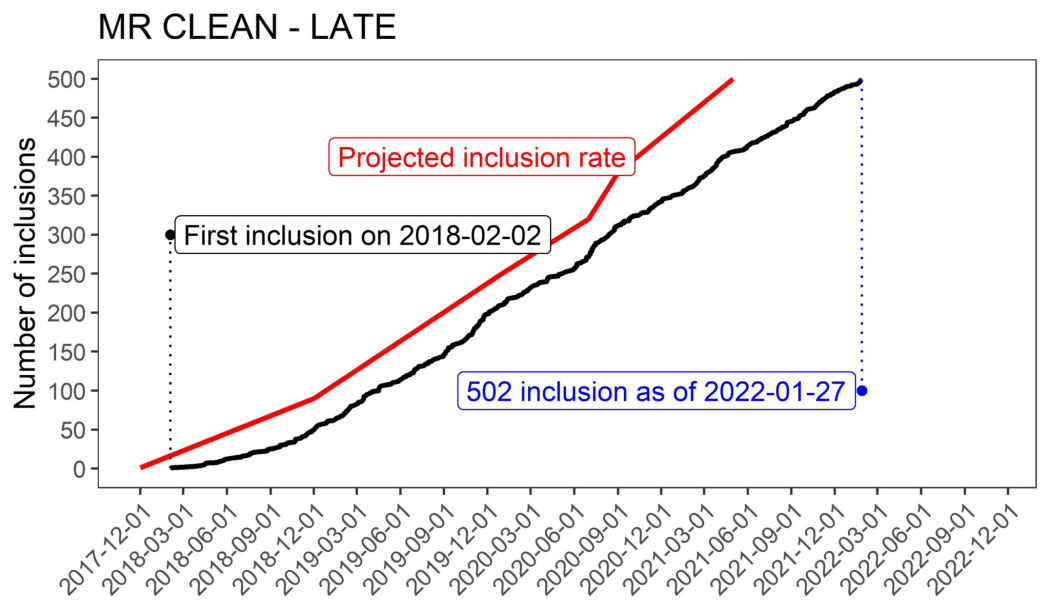
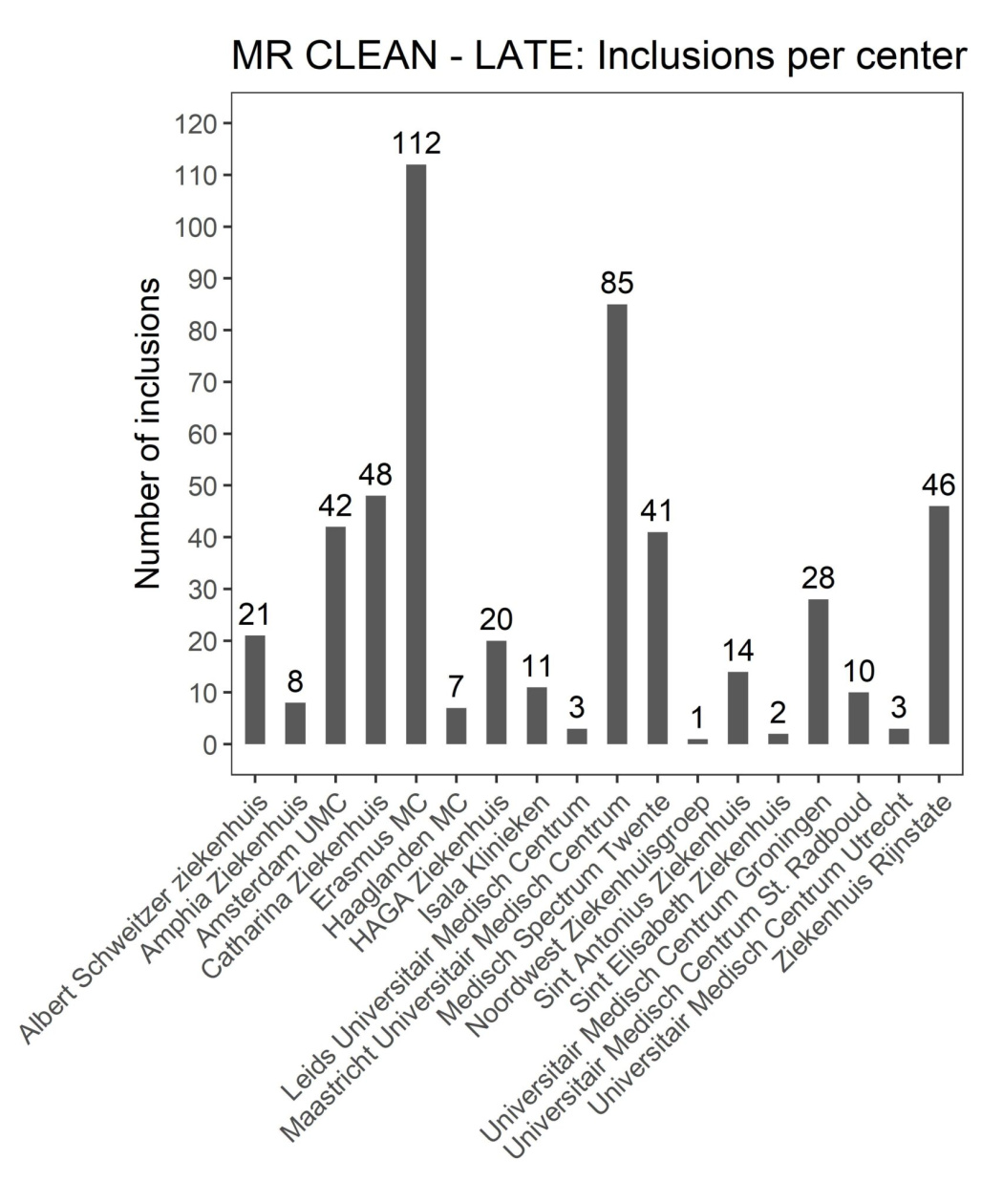
On the 27th of January 2022, the final patient (with registered consent) was included in the MR CLEAN LATE trial.
Results of the MR CLEAN-LATE trial have been published in the Lancet in April 2023: https://pubmed.ncbi.nlm.nih.gov/37003289/.
The long-term follow-up phase of the MR CLEAN-LATE has been published in the Lancet Neurology in September 2024: https://www.sciencedirect.com/science/article/pii/S147444222400228X?via%3Dihub
Kind regards,
MR CLEAN LATE principal investigators on behalf of the CONTRAST consortium.
Robert van Oostenbrugge and Wim van Zwam
Maastricht University Medical Center, Maastricht
MR CLEAN LATE Rationale and aim
Endovascular thrombectomy (EVT) by means of retrievable stents in patients with acute ischemic stroke (AIS) in the anterior circulation with confirmed proximal intracranial occlusion, in whom the procedure can be started within 6 hours from onset, has been proven safe and effective. Many patients present beyond the 6 hour time window. In the Netherlands up to 25% of AIS patients arrive in the hospital between 6 and 24 hours after symptom onset. Until recently no proven effective recanalization therapy was available for these patients.
This has been changed recently as the DAWN and DEFUSE 3 trial, published in 2017 and 2018, showed with convincing evidence that patients can benefit from EVT up to 24 hours after symptom onset or time last seen well, if they meet well defined clinical and/or imaging criteria.
- Patients in DAWN were randomized if they presented with severe neurological deficit (NIHSS>10) in combination with a small infarct core on perfusion (CTP) or diffusion (MRI DWI) imaging, a rare combination, occurring in less than 2% of all ischemic stroke patients, reflected by the relatively slow patient enrollment (total <2/wk in 26 participating centers). In 75% of the enrolled patients the infarct core was < 18ml, calculated with Rapid (Ischemaview) software. The large treatment effect observed in this study: absolute difference in chance of good outcome (mRS 0-2) of 36% (49% vs 13%), is therefore only to be expected in a similar group of patients.
- The DEFUSE 3 trial used broader inclusion criteria: NIHSS 6 and an infarct core of <70ml, but with additional minimal core-penumbra mismatch criteria on CTP or MRI DWI (again, like in DAWN, calculated with Rapid software) and a time window of 6 – 16 hours after symptom onset or last seen well. Despite these broader inclusion criteria, the finally studied population was similar to the DAWN study population with 75% of enrolled patients having an infarct core of < 25ml and a median NIHSS of 16 (compared to 17 in DAWN). The observed 28% increase in good outcome (45% vs 17%) was in line with, and confirmed, the results of DAWN.
Evidence for treatment benefit of EVT has therefore now been provided, and confirmed, for patients arriving beyond the 6 hour time window, meeting the above described criteria: small infarct core (< 25ml) on baseline imaging in combination with moderate to severe neurological deficit at presentation. In view of the large treatment benefit, it seems plausible that more patients may benefit from EVT in this ‘late’ time window. However, there is no evidence to support this and current guidelines therefor only recommend EVT for patients meting these strict criteria.
Because DAWN and DEFUSE 3 both used advanced imaging (CTP, MRI DWI), applying the same software for automated infarct core calculation, selection of patients meeting above mentioned criteria is limited to centers able to use these imaging techniques and either use Rapid software or know how their own infarct core calculations compare to the core volumes in DAWN and DEFUSE 3.
If evidence can be provided that patients who may benefit from EVT in the late time window can be selected with more widely available imaging modalities centers not able to use CTP or MRI DWI will be able to select these patients and rapidly refer them to an intervention center.
- In the ESCAPE trial, one of the trials that showed efficacy of EVT, patients were randomized in the 0 to 12 hour time window and were selected by NCCT and CT angiography (CTA). Eligible patients needed to have a small core infarct defined as an ASPECTS score of >5, and a moderate to good collateral flow on CTA. Of all recent trials, EVT was most effective in this selected population. Most patients were treated within 6 hours from symptom onset, whereas only a small proportion was treated between 6 and 12 hours after symptom onset. The effect size in patients treated beyond 6 hours was the same as in the early treated group. However, this predefined subgroup was too small to draw firm conclusions.
- Two subgroup analyses of the MR CLEAN study showed that of these two imaging parameters (ASPECTS score and collateral flow) only the degree of collateral flow showed interaction with effect of EVT.
Presence of collateral flow on CTA may therefore be an adequate criterion for patient selection in the late time window.
In order to expand the indication for EVT beyond the 6 hour time interval using widely available imaging modality, we aim to assess the effect of EVT compared to best medical treatment in patients with AIS caused by an intracranial large vessel occlusion of the anterior circulation, who have at least some collateral flow on CTA and who can be treated between 6 and 24 hours after symptom onset, or last seen well less than 24 hours before admission to the hospital (which also includes wake up strokes).
MR CLEAN LATE Study design
This is a multicenter clinical trial with randomized treatment allocation, open label treatment and blinded endpoint evaluation (PROBE design).
The intervention contrast is endovascular treatment versus no endovascular treatment. The treatment is provided in addition to best medical management.
Patients with AIS, ICH ruled out with non-contrast CT, a confirmed intracranial anterior circulation occlusion and poor to good collaterals on CTA will be included. Treatment should be started between 6 and 24 hours after symptom onset. Age should be 18 or over and NIHSS 2 or more.
The primary outcome is the score on the modified Rankin Scale at 90 days after inclusion.
MR CLEAN LATE Trial protocol
Click here for the study protocol.
MR CLEAN LATE Trial organzation
Project leaders:
• Robert van Oostenbrugge, neurologist, MUMC, Maastricht
• Wim van Zwam, intervention radiologist, MUMC, Maastricht
Study executive committee:
• Marianne van Walderveen, neuroradiologist, LUMC, Leiden
• Geert Lycklama a Nijeholt, neuroradiologist, MCH, The Hague
• Wouter Schonewille, neurologist, St. Antonius Hospital, Nieuwegein
• Maarten Uyttenboogaart, neurologist, UMCG, Groningen
• Charles Majoie, neuroradiologist, AMC, Amsterdam
Coordination researchers:
• Robert-Jan Goldhoorn, junior researcher, MUMC, Maastricht
• Wouter Hinsenveld, junior researcher, MUMC, Maastricht
• Anne-France Pirson , junior researcher, MUMC, Maastricht
• Susan Olthuis, junior researcher, MUMC, Maastricht
Independent expert:
• Bart Jacobs, neurologist, Erasmus MC
Subsidizing party:
• Dutch Heart Foundation; Hersenstichting
Statistical advisors:
• Hester Lingsma, methodologist, Erasmus MC, Rotterdam
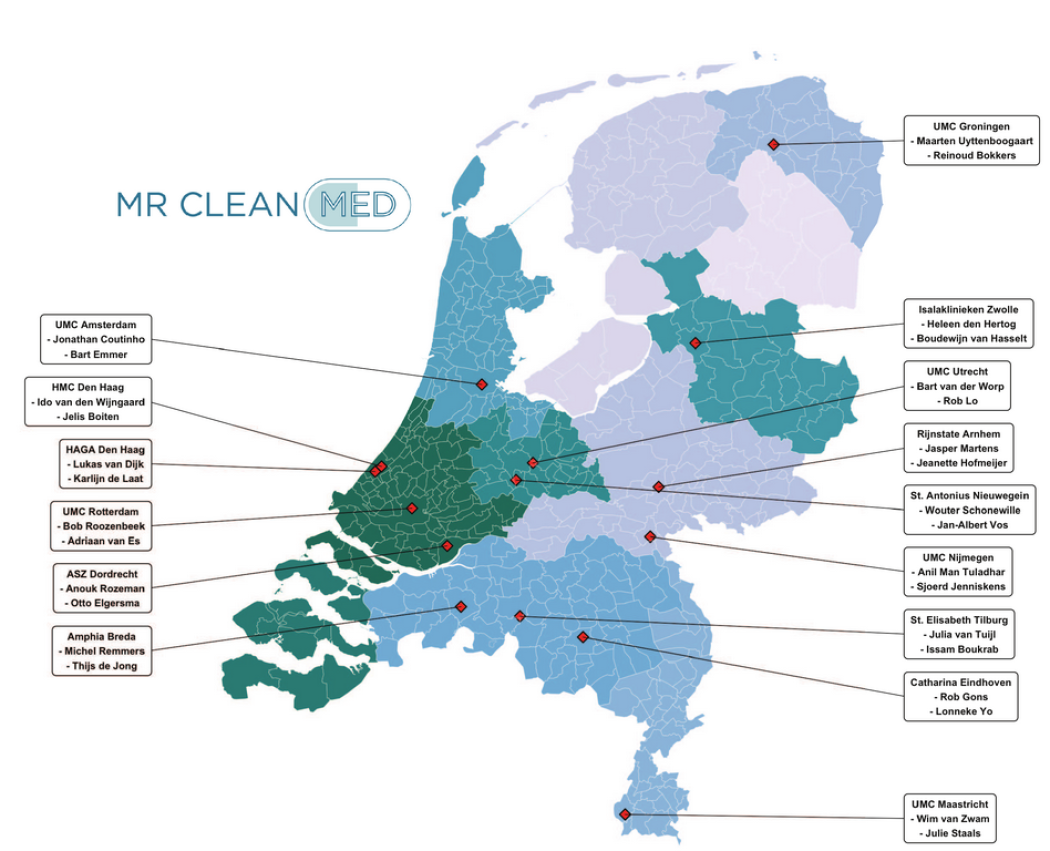
| Center | Location | PI Neuro | PI Radio |
| MUMC+ | Maastricht | J. Staals | W. van Zwam |
| Erasmus MC | Rotterdam | D.W.J. Dippel | A. van der Lugt |
| AMC | Amsterdam | J.Coutinho | C. Majoie |
| UMCU | Utrecht | B. van der Worp | R. Lo |
| UMCG | Groningen | M. Uyttenboogaart | R.P.H. Bokkers |
| Radboud UMC | Nijmegen | E.I. van Dijk | J. Boogaards |
| LUMC | Leiden | M. Wermer | M.A.A. van Walderveen |
| ETZ | Tilburg | J.H. van Tuijl | H. Kortman |
| Catharina | Eindhoven | R. Gons | L. Yo |
| St. Antonius | Nieuwegein | W.J. Schonewille | J. Vos |
| HAGA | Den Haag | K.F. de Laat | L. van Dijk |
| Haaglanden | Den Haag | I.R. van den wijngaard | G. Lycklama à Nijeholt |
| Rijnstate Ziekenhuis | Arnhem | J. Hofmeijer | J. Martens |
| Isala Klinieken | Zwolle | H. den Hertog | B. van Hasselt |
| MS Twente | Enschede | P.J.A.M. Brouwers | T. Bulut |
| Amphia | Breda | M. Remmers | T. de Jong |
| ASZ | Dordrecht | A. Rozeman | O. Elgersma |
| Noordwest Ziekenhuis groep | Alkmaar | B. van der Veen | D.R. Sudiono |
MR CLEAN LATE Progress of the trial
As of the 8th of January 2018, the MR CLEAN LATE has started with patient enrollment in the MUMC+.
MR CLEAN LATE Contact
MR CLEAN LATE trial office
Maastricht Universitair Medisch Centrum (MUMC+)
Tav. Wouter Hinsenveld & Robert-Jan Goldhoorn, Anne Pirson & Susan Olthuis.
Afdeling Neurologie
Postbus 5800
6202 AZ Maastricht
The Netherlands
late.trialoffice@mumc.nl
Tel: +31 6 51 44 77 76 (24/7)
Fax: +31 43 387 70 55
MR CLEAN LATE Extended Follow-Up
Click here for the statistical analysis plan.